

Please Note: This post contains honest discussions regarding clinical depression and suicidal ideation. If these topics are distressing or triggering for you, please consider skipping this read. If you are currently struggling or in a dark space, please reach out for help. You are not alone.
- National Suicide Prevention Lifeline: Call or text 988 (Available 24/7 in English and Spanish)
- Crisis Text Line: Text HOME to 741741
The End of a Chapter

When my therapist told me she was leaving, I felt something collapse inside of me. It felt like a breakup—not because of romance, but because she had been my lighthouse for nearly a decade.
Intellectually, I knew she wasn’t abandoning me. Life was simply moving her family in a different direction. But emotionally, it felt like losing a foundational piece of my architecture. You don’t spend nine years letting someone witness your trauma, obsessions, and breakthroughs without forming a deep emotional attachment. She had become part of the structure holding my life together.
I think I always knew this day would come. Therapists retire; people move. I understood that. I just never let myself imagine what it would feel like when the anchor finally let go.
In those final sessions, we talked about what came next. She recommended a new therapist—younger, more progressive, interested in alternative treatments like psychedelics. Somewhere in those conversations, there was an unspoken truth hanging in the air: She didn’t know what else she could do for me.
That sounds harsher written out than it felt in the room. It wasn’t rejection; it was the natural end of a chapter. She had helped me survive, helped me stay alive through the darkest years. But we both knew she couldn’t magically lead me to a perfect answer that would erase my suffering.
In early 2025, we had our last session. There was no dramatic movie scene. No handshake. Just two people in the same room they had sat in for years. Near the end, she said something personal that tied everything together, and for the first time in nine years of constant talking, I was completely tongue-tied.
The Collapse

Underneath the goodbyes, I was drowning.
Everything felt destabilized. I stopped my Spravato treatments because I couldn’t tell if they were working anymore. I lost faith in my chemistry. I stopped taking most of my medications altogether. I slept on my couch for weeks because my bedroom was a disaster and carried too many bad memories. I was taking large amounts of Benadryl just to stay disconnected from reality.
One night, at four in the morning, I was messaging a close friend. I told him I didn’t care if I woke up the next day. I wasn’t planning an act, but I was done participating in survival. He asked if I had a plan. Casually, flippantly, I described how I would do it. Then I rolled over and went to sleep.
But at four in the morning, the line between “fantasy exhaustion” and “active intent” is invisible to everyone but the person drowning.
A while later, the police arrived and escorted me to the ER. At first, I felt betrayed. I thought I was just venting. But looking back, what else was he supposed to do? If someone you care about describes their exit, you don’t get the luxury of assuming they’ll be okay.
I spent hours in a monitored ER room being evaluated. Eventually, they determined I was safe enough to return home. I avoided the psychiatric ward, went back to my apartment, and went right back to sleep.
Learning to Pedal

In the spring of 2025, I walked into my first session with the new therapist already exhausted by the idea of starting over. But I also saw my psychiatrist and told her something had to change. We adjusted my cocktail, and I committed to being compliant with my meds again.
I started dumping my entire history into these new sessions. Nothing was off-limits. I just talked and talked. And then, something started to change.
I struggle to explain it even now, but I know that it happened. It felt as if my psyche finally rebelled against the darkness. It was as if the training wheels had finally come off, and instead of immediately crashing face-first into a ditch, something inside me actually started pedaling.
I was different.
Not “cured.” Not magically happy. But I wasn’t drowning. I started cleaning my apartment every day. I moved back into my bedroom. I turned my apartment into a home instead of a bunker. I created routines. I built structure.
And for the first time in thirty-five years, I noticed something shocking: I was recovering.
I still have bad days. My moods can still be a rollercoaster. But the difference is the “snap back.” I recover emotionally in ways I never used to. I’m participating in my own life again.
The Grail

So, did I finally find the Holy Grail? In a very unexpected and still somewhat mysterious way… yes.
I can’t say for sure what the catalyst was. Was it the Spravato forging new pathways while I slogged through the years? Was it the new medication clicking with the old? Or was losing my longtime therapist such a psychological shock that it forced me to learn how to swim on my own?
I think the answer is somehow all of those things and none of those things at the same time.
So, was this the grail that the Trazodone had been? In some ways yes, and in some ways no. But it was a grail.
Maybe years of treatment, therapy, adaptation, grief, medication, survival, and sheer exhaustion finally lined up in a way my brain and psyche were ready to accept. Or maybe it was simply my time in the universe to finally emerge from it.
I want to say the culmination of thirty-five years of psychological torture finally loosened its grip enough for me to breathe again. And once I felt that shift happening, I ran with it.
I didn’t look back.
I started living differently. I built routines and stuck to them. I started taking care of my environment. I started feeling gratitude more often than rage toward a God I wasn’t even sure I believed in.
And the strangest part is this: I really am different now.
For years, I imagined recovery like the end of The Last Crusade—standing in a room of endless chalices, convinced that if I just picked the “True Cup,” I’d be healed forever. One perfect pill. One perfect answer.

But recovery didn’t arrive like magic. It arrived through years of surviving long enough for the pieces to finally work together.
This is where the Superman metaphor comes back for me.
For years, I looked at that iconic image of Superman—bracing his shoulders against the weight of a crumbling world—and I saw my medications. I saw my therapist. I saw the “Grail.” I thought they were the only things strong enough to keep the tracks from snapping under the weight of my depression.
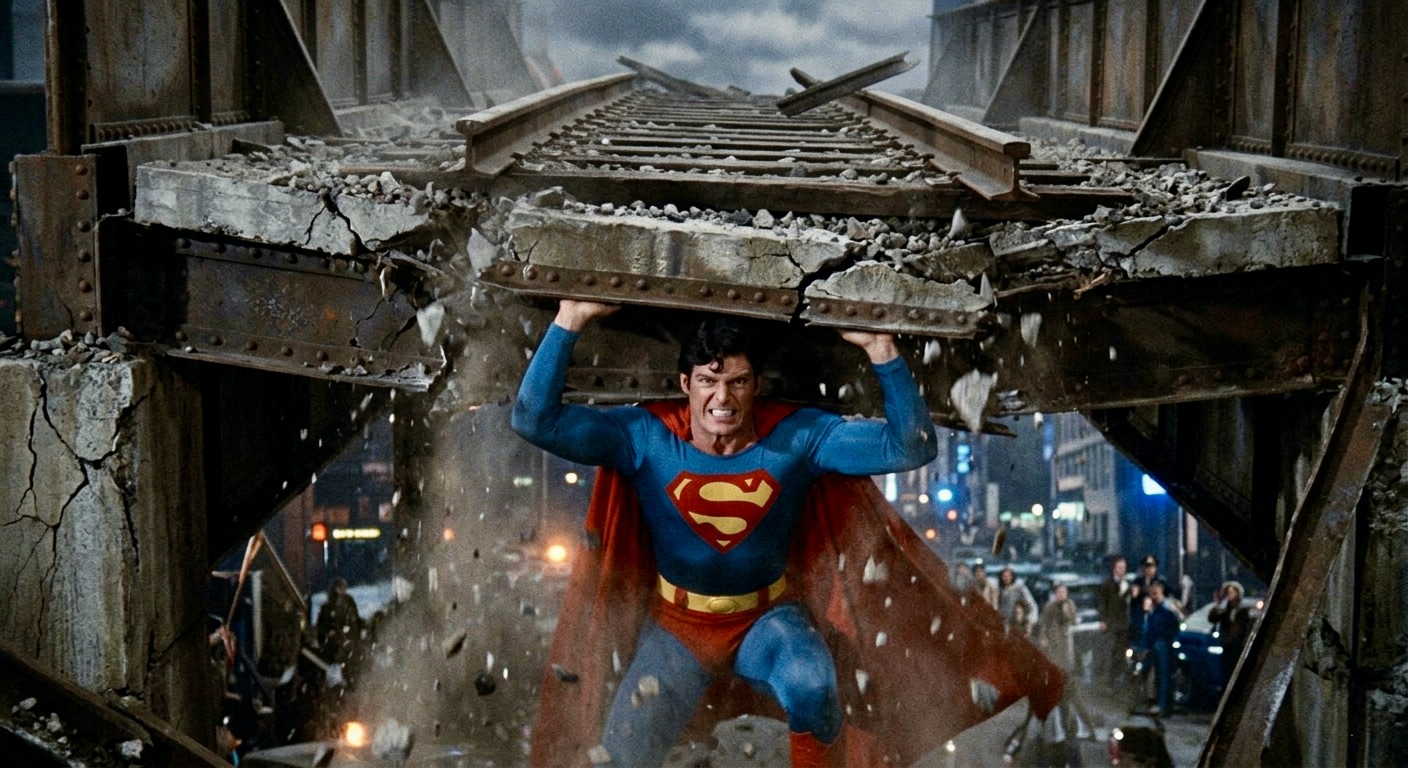
But I see it differently now.
The medications provided the structure. The therapy provided the blueprints. The people who loved me provided the light so I could see what I was doing. But they weren’t the ones under the tracks.
I was.
I spent thirty-five years developing the muscles of a survivor without even realizing it. I thought I was just failing to stay afloat, when in reality, I was becoming strong enough to eventually carry my own weight.
The miracle wasn’t a magic chalice or a sudden flight into the sun. The miracle was the moment I realized that the tracks were holding because I was holding them.
I’m still on the ground. I’m still human. I still feel the weight. But the cape isn’t a costume anymore; it’s the quiet resilience of a man who decided to stop waiting for a savior and started becoming his own.
The world is still heavy, but I am finally, finally, light enough to lift off.
I believe a man can fly.

Thanks for reading Fess UP! My Journal Out Loud! This post is public so feel free to share it.

Member discussion: