

I performed for people most of my life.
I learned how to be funny, easy to be around, good company, the version of me that could walk into a room and make things lighter. I could go out, hang with friends, be present, be entertaining, be whatever the moment seemed to need.
Then I would come home and crash.
Not just tired. Emptied out.
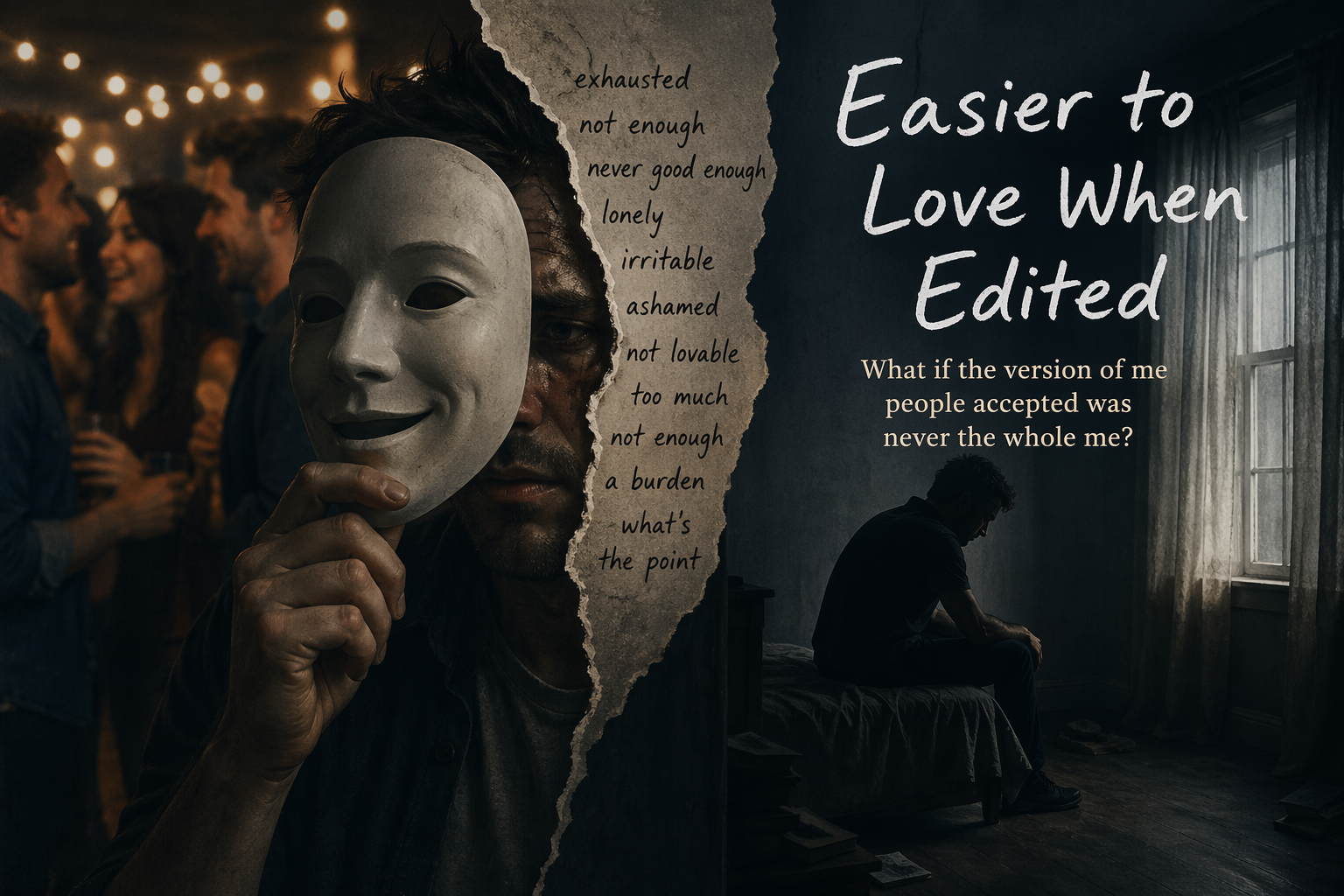
I needed to recharge enough to be “myself” again—or at least the version of myself that everyone else seemed to enjoy. It was like borrowing energy from some private reserve just to be socially acceptable, then paying it back in isolation.
Easier to love when edited.
I want to be clear about something: I do not blame anyone else for that editing. My friends, more often than not, encouraged me, cared about me, included me, and wanted me around. Many people in my life gave me more room than I knew how to take. They were not demanding a performance as much as I was volunteering one.
No one forced the mask onto me.
A lot of the pressure came from inside.
For a long time, that performance felt necessary. Maybe it was. I used to be terrified that if anyone saw my pain, I would be exposed. That something in me would crack open in front of everyone. That I would start crying, lose control, embarrass myself, and be seen as weak, dramatic, pathetic, too much.
I still think like that more often than I want to admit.
Less now than before, but still.
So I learned to keep everything contained. Keep the face steady. Keep the voice normal. Keep the hurt hidden. Keep the mask polished.
And yet I have had genuine moments in my life.
I know that because I have been loved twice in ways that felt real. The first time I fell in love, and the second time too, they saw the best and worst of me. They saw tenderness, flaws, warmth, insecurity, mistakes, hope, fear. They saw more than the polished version.
That happened.
Which means I know some version of genuineness has existed in me before.
But that was decades ago.
A different me ago.
Now I’m not performing as much, and without that familiar version of me doing all the work, all I seem to notice is some negative, grouchy guy underneath it. Raw. Irritable. Hard to please. Unlikeable. Unlovable.
That is my fear anyway.
And no matter what the deeper truth might be, that is how it feels right now.
Now I feel like a depressed attention whore ruining friendships and nowhere near stable enough for a relationship. That sentence is ugly to write, but it is honest about how brutal my inner voice can be. Loneliness grows well in that kind of soil.
When I imagine authenticity, I don’t picture freedom. I picture people meeting what’s left and quietly deciding they preferred the edited version.
What if the performance wasn’t hiding goodness?
What if it was hiding ugliness?
But maybe I’ve been too quick to mistake symptoms for identity.
Maybe depression is not personality.
Maybe loneliness is not worthlessness.
Maybe need is not narcissism.
Maybe struggling out loud is not attention-seeking.
Maybe exhaustion is not character.
Maybe resentment is not essence.
Maybe anger is not all that remains.
Maybe difficulty is what tenderness becomes when ignored too long.
Maybe bitterness is what surfaces first when someone has been edited for years.
Maybe crankiness is what comes out when needs have gone untranslated for too long.
I didn’t lose authenticity. I practiced survival until authenticity became unfamiliar.
I learned how to minimize myself before I learned how to understand myself. I learned how to be manageable before I learned how to be honest. I learned how to suppress discomfort before I learned how to express it cleanly.
So now it can feel like I only have two settings: performance or irritation. Pleasing or shut down. Easy or raw.
If those are the only versions of me I know, of course authenticity feels terrifying.
Even writing this, I question whether I am being genuine or genuine enough. I question whether my version of things matters. I wonder why anyone would want to read this when everyone has issues. Everyone has loneliness. Everyone has insecurity. Everyone has pain.
Maybe that is exactly why someone would read it.
Not because my suffering is unique.
Because it isn’t.
Because the private language of shame often sounds familiar in other people’s heads too.
Maybe people do not read to meet extraordinary lives.
Maybe they read to feel less alone inside ordinary pain.
Maybe underneath the performance is not a monster.
Maybe it is an underdeveloped self carrying too much frustration.
Maybe what I call fake is adaptation.
Maybe what I call broken is disconnection.
Maybe what I call difficult is pain that never learned a better language.
I still don’t know how to be genuine without flinching.
I still don’t know what rises when I stop editing myself.
But I’m starting to suspect the first draft is not the final version.
And maybe the real me is not gone.

Member discussion: