

THE PERFORMANCE OF BEING OKAY
A Play in Four Acts

CHARACTERS:
- JERRY: A musician, artist and writer. He looks like he’s holding his breath.
- THE REPRESENTATIVE: Jerry’s “Social Self.” Dressed in a suit that is slightly too small, wearing a permanent, strained smile.
- THE DOCTOR: A figure of cold authority, constantly checking a watch that doesn’t move.
- THE CHORUS: A group of figures in hoodies, illuminated only by the blue light of their smartphones.

ACT I: THE ARCHAEOLOGY OF “NO”
(Setting: A void. JERRY is trying to draw a circle on the floor with a piece of chalk. THE REPRESENTATIVE follows behind him with an eraser, frantically rubbing the lines out.)

JERRY: (Stopping) Why are you doing that? I need that line. I need to know where I end and they begin.
THE REPRESENTATIVE: (Breathless) We can’t afford the line, Jerry. Lines are expensive. Lines create friction. Friction creates heat. And heat makes people leave the room.
JERRY: I’m fifty years old. I’m tired of being a floor mat.
THE REPRESENTATIVE: You aren’t a floor mat. You are “easygoing.” You are “the flexible one.” You are the “low-maintenance friend” everyone loves because you never take up any space.
JERRY: I’m not flexible. I’m just afraid. I tossed my boundaries to the side decades ago because I thought they were barricades that would keep my friends out. I thought if I said “No,” I’d be saying “Goodbye.”
THE REPRESENTATIVE: Exactly! It’s a bargain. We trade the self for the seat at the table. Now, stand up straight and look agreeable. Someone might be looking.
ACT II: THE BURDEN OF PROOF
(Setting: A sterile exam room. The sound of a fluorescent light humming loudly. THE DOCTOR stands on a pedestal, looking down at JERRY through a magnifying glass.)

JERRY: It’s… it’s a dull roar today. It’s heavy.
THE DOCTOR: (Interrupting) You’re articulate. Your vitals are stable. You just made a witty remark about the wallpaper. People in “real” pain don’t tell jokes, Jerry.
JERRY: (To the audience) And there it is. The Trap.
THE REPRESENTATIVE: (Sprinting onto the stage, throwing a heavy, tattered gray cloak over JERRY’S shoulders) Quick! Stop smiling! Look haggard! Limp a little!
JERRY: (Struggling under the weight of the cloak) I shouldn’t have to do this. The suffering is real whether I’m laughing or crying.
THE REPRESENTATIVE: In this room, if you aren’t performing, you aren’t hurting. Invisible illness requires a witness, and the witness requires a show. If you don’t give him a Broadway-level performance of agony, he’ll write “Patient is fine” in the chart and walk out.
JERRY: (To THE DOCTOR, his voice straining) I can’t sleep. I can’t sit. I am… I am falling apart.
THE DOCTOR: (Scribbling) Better. Now I can almost believe you.
ACT III: THE DIGITAL TELEPATHY
(Setting: JERRY sits center stage at a desk. THE CHORUS stands in a semi-circle behind him, their faces glowing blue.)
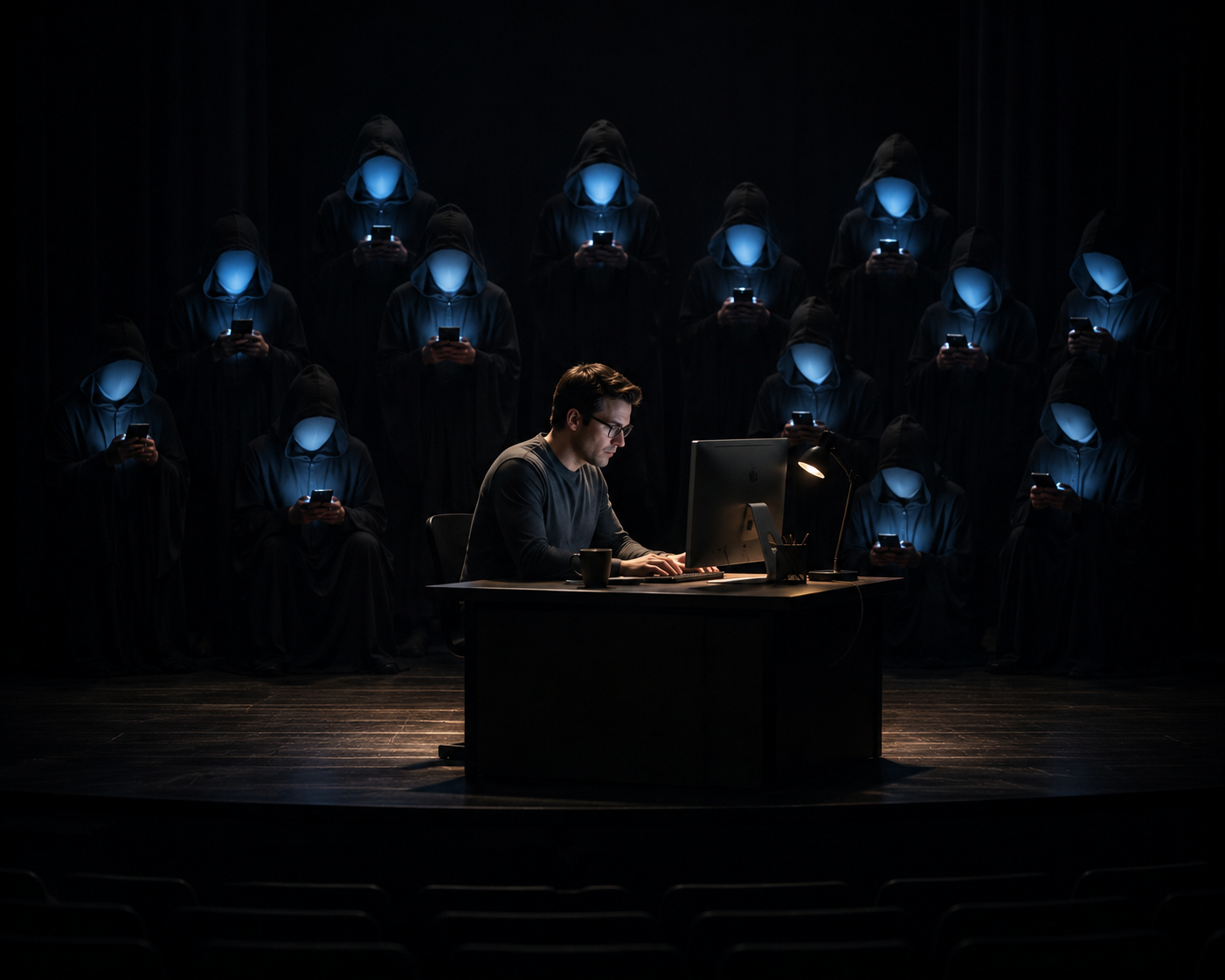
JERRY: (Typing) I spent my life over-explaining. Writing long emails to justify my feelings. Providing courtroom-level evidence for my boundaries.
THE CHORUS: (In unison, a rhythmic chant) We don’t explain anymore. We expect. We don’t ask anymore. We demand.
VOICE 1: You used a word that triggered my third-grade trauma. VOICE 2: You didn’t acknowledge my specific neurodivergence in your subtext. VOICE 3: Why didn’t you navigate my map? I never showed it to you, but you should have seen it.
JERRY: I can’t read your minds! I spent fifty years learning to speak up, and now the world says I should have known what you needed telepathically?
THE CHORUS: Misunderstanding is cruelty! Confusion is a call-out!
JERRY: No. It’s basic cancel culture. You’re setting tripwires and calling them “awareness.” You’re waiting for me to fail a test I didn’t know I was taking so you can feel the rush of “canceling” a stranger.
THE REPRESENTATIVE: (Terrified) Jerry, stop! You’re being “difficult”! They’re going to unfollow!
JERRY: (Standing up, pushing THE REPRESENTATIVE aside) Let them! Real understanding isn’t a download. It’s a relationship. It’s the messy, slow work of two people risking the truth. It’s me saying, “This is hard for me,” and you not requiring me to perform it perfectly before you believe me.
ACT IV: THE NEW MAP
(JERRY walks to the edge of the stage. He picks up the chalk again. He draws a single, solid line between himself and the audience. He doesn’t look at THE REPRESENTATIVE.)

JERRY: I used to think putting up a boundary meant I was bad at being a friend. I used to think it was a sign of failure.
THE REPRESENTATIVE: (Quietly) And now?
JERRY: Now I realize that people who get angry when you set a boundary are usually the ones who benefited from you not having any. I’m bad at reinforcing them, sure. I still stumble. I still want to collapse when things get tense.
THE REPRESENTATIVE: It’s safer to collapse.
JERRY: It’s quieter. But it’s not safer. Because when you collapse, you disappear.
(JERRY steps over his chalk line, then steps back. He smiles—a real one this time.)
JERRY: A boundary isn’t a wall. It’s just the moment I stop believing that belonging should cost me my soul.
(JERRY turns off the desk lamp. The blue glow of THE CHORUS fades into total darkness.)
CURTAIN.

EPILOGUE
The stage remains dark for a long beat before a single, warm spotlight finds JERRY sitting at the edge of the apron, his feet dangling over the orchestra pit. The Representative is gone, and the Chorus has fallen silent. He looks out at the audience—not as a performer seeking a witness, but as a man finally comfortable in the quiet. He realizes that for half a century, he treated his own life like a guest room, perpetually keeping it tidy and vacant so that no one would ever feel inconvenienced by his presence. He had mastered the language of everyone else’s needs while leaving his own vocabulary stunted, assuming that a well-defended heart was a lonely one.
He stands up, brushes the chalk dust from his hands, and realizes the most important boundary he ever drew wasn’t a fence to keep others out, but a hearth to keep himself warm. He finally understands that the only people who ever asked him to be invisible were the ones who were never truly looking at him anyway.
(Blackout.)

Member discussion: