

Somewhere along the way, people started confusing love with punishment.
They call it tough love, but what they often mean is criticism, shame, emotional withdrawal, or superiority. It’s a way of walking away while still getting to feel like the “bigger person.”
That’s not love. That’s cruelty with better branding.
And some of the worst versions of it don’t happen in families or institutions—they happen in friendships
The “Ascended” Friend
Nothing is stranger than a friend who decides they are suddenly above you.
You know the type:
- The one who acts like they’re the grown-up and you’re the lesson.
- The one who talks to you like you’re unfinished.
- The one who treats your struggles like a stage for their insight.
They use phrases like, “I’m just being real with you” or “You need to hear this,” but the subtext is usually:
I enjoy judging you, and I want to do it without consequences.
That isn’t friendship. That’s hierarchy dressed up as care.
Honesty vs. Humiliation
Don’t get me wrong, I’ve needed real honesty before.
I’ve needed people to call me out when I was being avoidant or making excuses. I’ve needed people to challenge me when I was stuck.
But there is a world of difference between honesty and humiliation.
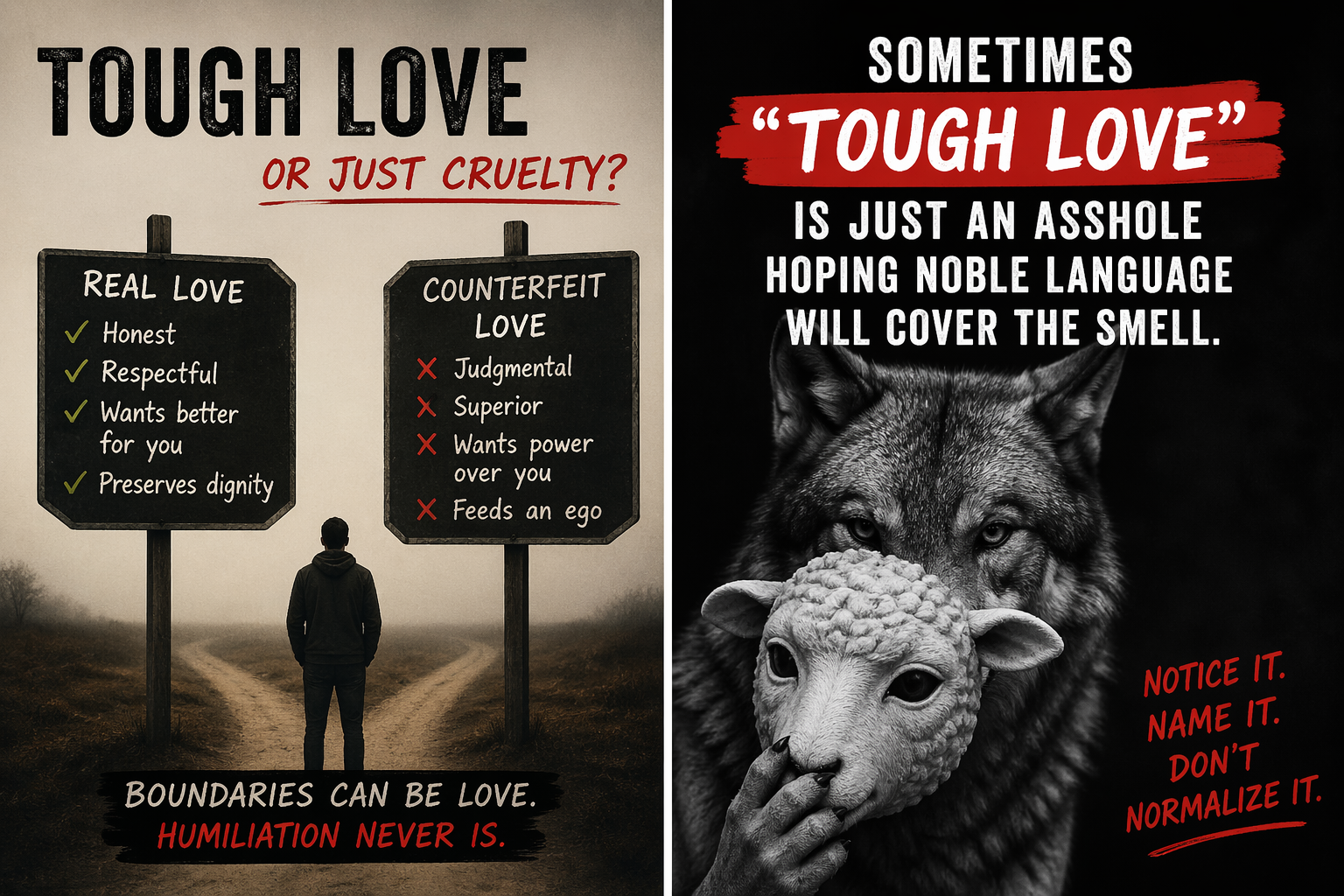
Real love wants better for you.
Counterfeit love wants power over you.
A real friend says:
“I’m worried about you—can I be honest about what I’m seeing?”
A fake friend says:
“Someone had to tell you. You’re just too sensitive.”
One preserves dignity.
The other feeds an ego.
The Science of the “Sting”
Psychology backs this up.
Research shows that shame - the feeling that I am bad - is linked with withdrawal, resentment, defensiveness, anxiety, and depression. Guilt - the feeling that I did something bad - is more likely to motivate repair and change.
When someone uses “tough love” to degrade or belittle you, they usually aren’t helping you grow.
They are triggering a shame response that causes many people to collapse, hide, or defend themselves—not evolve.
They are deepening the harm while congratulating themselves for their “bravery.”
Friendship Is Not a Monarchy
No healthy friendship requires one person to be permanently cast as “the mess” while the other plays “the mentor.”
If someone constantly needs to teach you lessons, they may like power more than they like you.
- If they wound you and call it honesty, notice that.
- If they disappear and call it boundaries, notice that.
- If they need you smaller so they can feel bigger, run.

The Bottom Line
Boundaries are real.
Consequences are real.
Sometimes you do have to walk away from someone for your own sanity.
But distance doesn’t require a lecture.
And leaving doesn’t require stepping on someone’s throat on your way out.
Real love can be firm. It can say no. It can even walk away.
But real love never needs to humiliate you to feel strong.
It doesn’t need your pain to prove its point.
If someone tells you they’re hurting you for your own good, ask yourself:
Who is actually benefiting here?
Because sometimes “tough love” is just an asshole hoping noble language will cover the smell.
In those cases, the healthiest response is simple:
Fuck off.

Member discussion: